

Disclaimer:
This article is intended to assist business owners in understanding different intellectual property (IP) from a business perspective. As we do not practice IP registration, prosecution or enforcement, the information provided is for general informational purposes only.Readers are advised to seek qualified IP lawyers or IP agents for such matters.
Under Malaysian law, depending on what a business intends to protect – logo, software, formula, or brand name –separate IP legislation often applies, along with different legal protections, registration requirements and durations.
For those who want more clarity on how to establish their proprietary rights in Malaysia, this article gives an overview of:
- the three main IP categories
- its impact on company value
- where IP considerations arise in commercial agreements, and
- where corporate & commercial lawyers play a practical role
Let’s begin.
Types of IP protection in Malaysia
| Copyright | Patent | Trademark | |
| Governing statute | Copyright Act 1987 | Patents Act 1983 | Trademarks Act 2019 |
| What it protects | Expression of creative ideas such as literary, artistic, musical, software, databases | New inventions (often technical) such as products or processes that are novel, inventive, and industrially applicable | Signs / brand identifiers such as words, logos, shapes, colours, distinguishing goods or services |
| What it does not cover | Ideas or concepts | Scientific theories, business methods & discoveries | Generic or purely descriptive terms |
| Registration | Not required. Arises automatically on creation. | Mandatory with MyIPO. No registration, no protection. | Recommended. Unregistered marks rely on common law passing off. |
| Duration | Life of author + 50 years | 20 years from filing (non-renewable) | 10 years, renewable indefinitely |
| Key risk | Ownership disputes in employment and contracting arrangements | Public disclosure before filing destroys patentability | Non-use for 3+ years may lead to revocation |
While most SMEs are primarily concerned with copyright and trademarks, patents tend to arise in manufacturing, technology, and product-development businesses where a novel invention is being commercialised.
IP ownership and company value
Well-documented IP ownership strengthens a company’s commercial position: whether in a fundraising round, a trade sale, or a joint venture negotiation. Investors and acquirers will look at whether key IP is registered, whether ownership has been properly assigned from founders or early contractors, and whether there are any unresolved infringement risks.
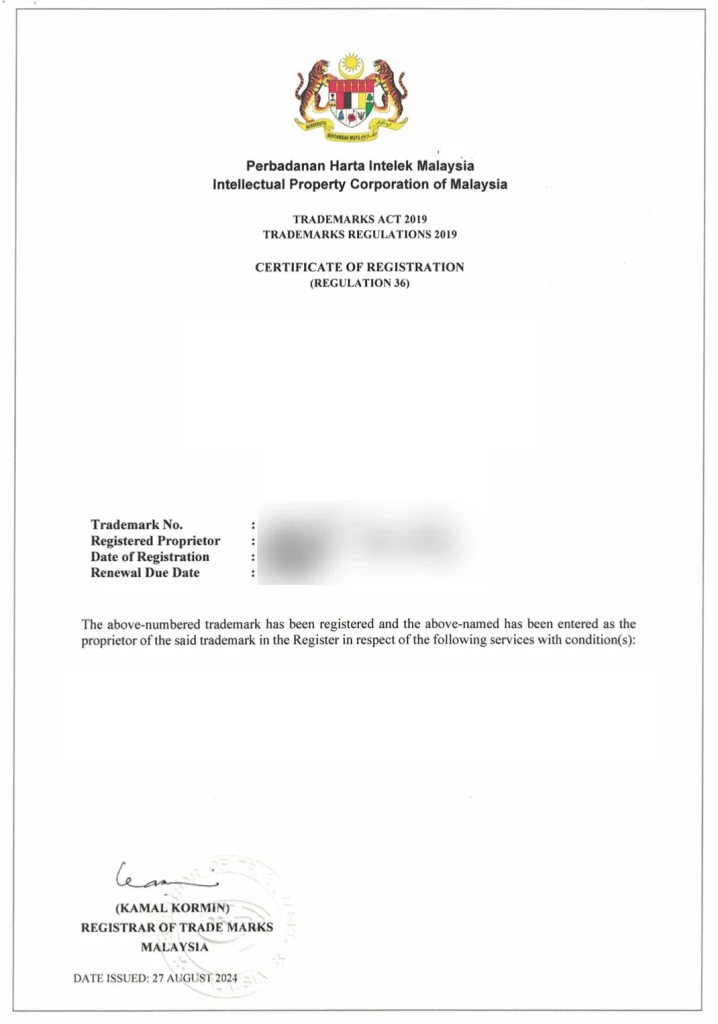
A company that cannot clearly demonstrate it owns its core IP may face renegotiation of deal terms or deferred completion pending remediation. Getting IP documentation right early avoids those complications.
Provisions in legal agreements
Employment agreements
Copyright in works created by an employee in the course of employment generally vests in the employer under section 26(2) of the Copyright Act 1987.
Even so, employment agreements usually includes clear IP assignment provisions and ownership covering all works created in connection with the role for clarity purpose.
Service agreements
For works created under commission, the default position favours the commissioning party as copyright vests in the person who paid for the work, not the contractor who produced it.
A contractor who wishes to retain rights in their work, or limit what is transferred, needs to address this expressly in the engagement letter or service agreement (i.e., this is of modern relevance to content creators).
Either way, written IP provisions matter: for the engaging party, to confirm what they own; for the contractor, to protect what they do not intend to give up.
Shareholders’ agreements
Where a founder has developed IP before incorporation and subsequently contributes it to the company, the Shareholders’ Agreement should document the terms of that contribution: whether it is an outright assignment or a licence, and whether any consideration is involved.
Joint venture agreements
Joint venture agreements typically address which party brings in what IP, what each party may do with jointly developed IP, and what happens to the IP if the joint venture is unwound.
Field-of-use restrictions and sublicensing rights are common commercial issues that should be resolved at the drafting stage.
M&A and due diligence
IP ownership is a standard item in a mergers & acquisitions due diligence. The key questions are whether the target company actually owns the IP it uses, whether assignments have been properly executed, and whether any third-party licences carry change-of-control provisions that may affect the deal.
Let ELP support your commercial agreements
Whether you are a business owner contributing IP to a new arrangement, or the one engaging and paying for it to be created, clear documentation determines who holds the rights and who captures the value. We can assist with ensuring those rights are properly secured in your agreements from the start. Contact us for an initial consultation.